US import · HS 761699
Trade measures change landed cost
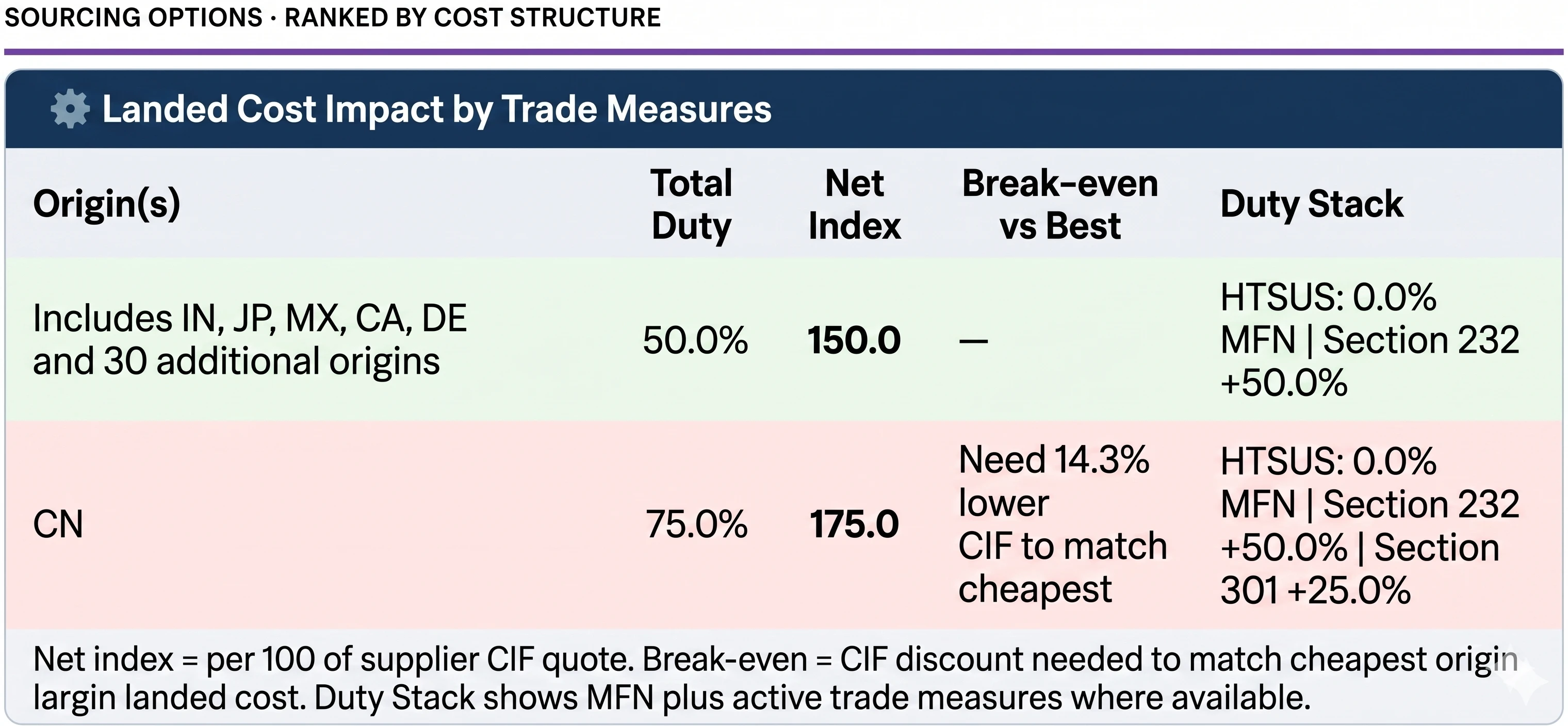
For U.S. aluminium imports, Section 232 raises the duty stack for most origins, while China faces an additional Section 301 layer and needs a lower CIF quote to compete.
Logitality helps procurement teams compare supplier countries by landed cost, duty exposure, market share, FX movement, supply depth, feedstock pressure, and corridor health across US, EU, and India import markets.
Shipment databases are useful for finding buyers and suppliers. Logitality answers the next procurement question: which supplier country is structurally advantaged after duties, taxes, FX, supply depth, and trade policy are considered?
| Question | Shipment / supplier database | Logitality sourcing intelligence |
|---|---|---|
| Who trades this product? | Strong — company and shipment discovery | Directional — origin-level market structure |
| Which country should I source from? | Limited — buyer still analyzes duty, FX, and risk manually | Core workflow — ranked supplier-country decision |
| What is the landed-cost impact? | Usually limited or separate | Duty, tax, FX, trade measures, and break-even logic |
| What happens if policy changes? | Manual follow-up | Scenario-based sourcing guide and corridor health signal |
| What should procurement do this week? | Lead list | Origin recommendation, risk signals, and action logic |
Logitality turns tariff stacks, duty exposure, FX, compliance risk, and supply depth into practical supplier-country decisions.
For U.S. aluminium imports, Section 232 raises the duty stack for most origins, while China faces an additional Section 301 layer and needs a lower CIF quote to compete.
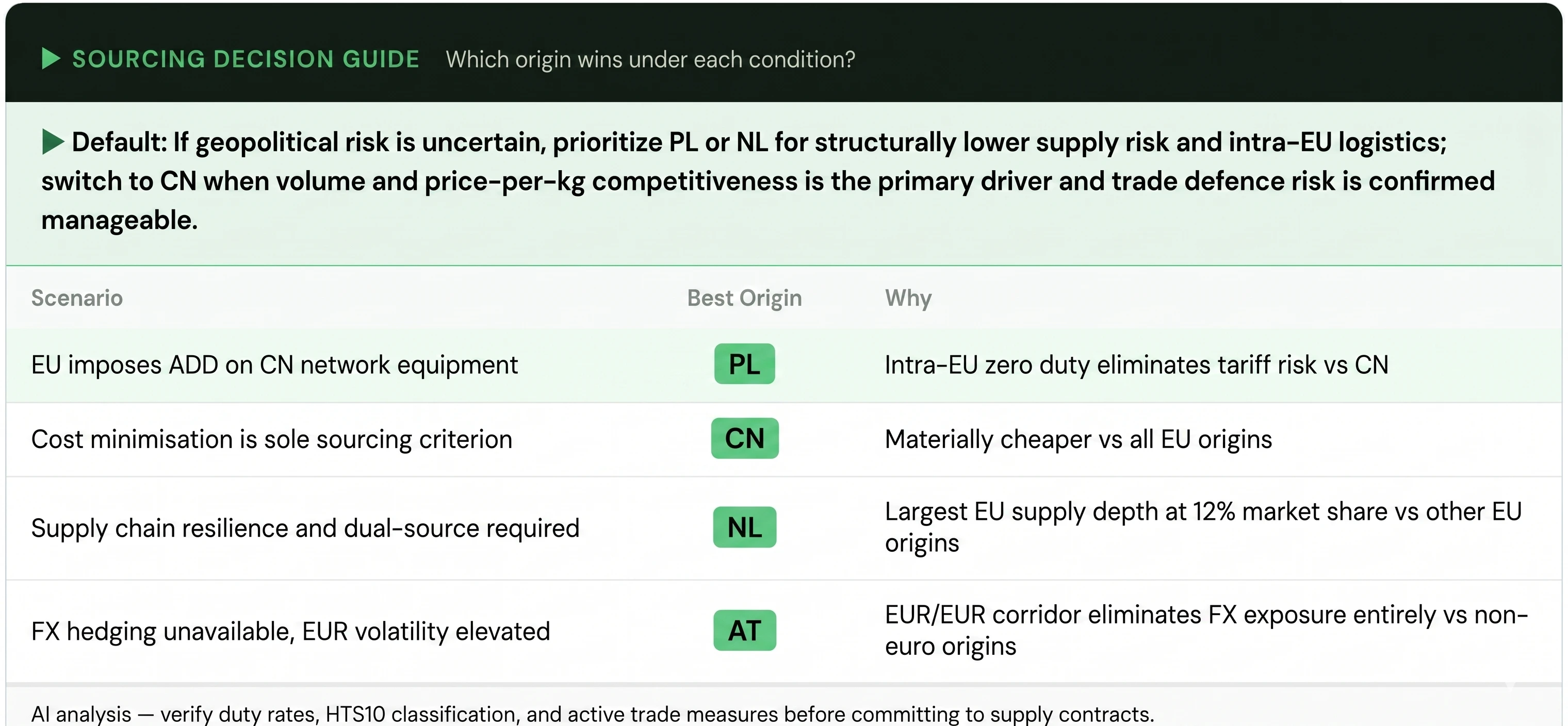
For network equipment imports into Germany, the best supplier country changes depending on China trade-defence risk, cost minimization, supply resilience, and FX exposure.
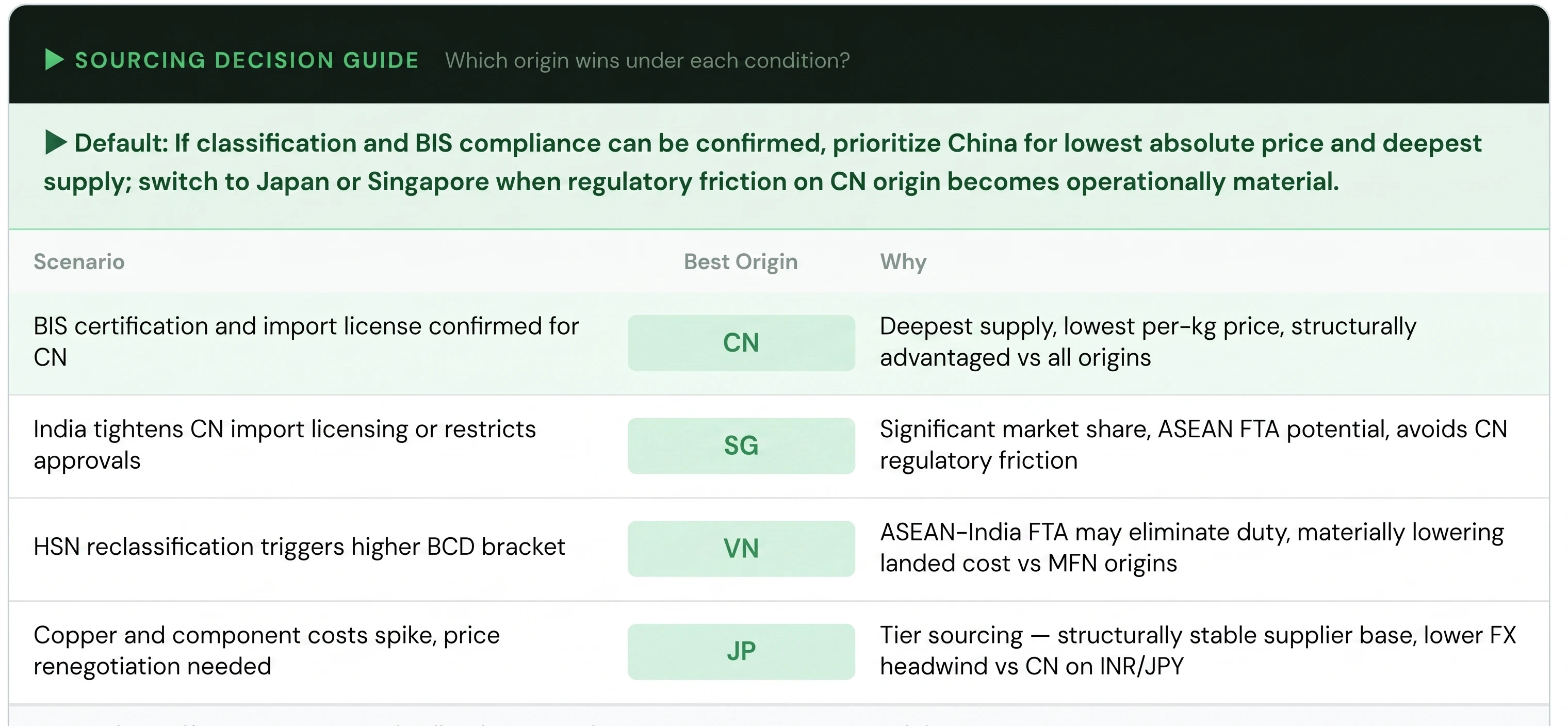
For imports into India, Logitality compares China, Singapore, Vietnam, and Japan under BIS compliance, import licensing, HSN classification, and component-cost scenarios.
Sourcing decisions are rarely about price alone. A lower supplier quote can disappear once duties, trade measures, FX movement, supply concentration, and feedstock pressure are included.
Compare which countries already supply your destination market, how much share they hold, and whether the supply base is concentrated or diversified.
See how duty, VAT or IGST, trade measures, FX, and freight availability affect the true economics of each origin.
Monitor GREEN, AMBER, or RED signals based on FX movement, input-cost pressure, and supply concentration.
Each Logitality sourcing report combines trade flows, tariff data, cost pressure, FX exposure, and AI guidance into a practical sourcing decision.
BACI 2024 import and export structure showing which supplier countries are already active in the market.
Origin concentration and sourcing diversity, helping identify whether a market is dominated by one origin or spread across many.
MFN duties, VAT, IGST, SWS, and origin-specific measures where available for US, EU, and India import markets.
Section 232, Section 301, anti-dumping flags, safeguards, quota logic, and classification-sensitive duty ranges where available.
90-day buyer-vs-origin currency movement with adverse and favourable changes explained in procurement terms.
Commodity and energy pressure mapped to products: steel, aluminium, copper, crude, gas, dairy, chemicals, and more.
Supplier countries ranked by market share, duty treatment, supply depth, and corridor economics.
GREEN, AMBER, or RED sourcing conditions based on FX, feedstock pressure, and supply concentration signals.
Default recommendation plus scenario alternatives for tariff changes, FX moves, supply risk, and compliance conditions.
Logitality's strongest duty-stack coverage is focused on the import markets where tariff and classification complexity most often changes sourcing decisions.
HTSUS duty logic, HTS10 support where available, Section 232, Section 301, and US trade-measure rows.
TARIC10 MFN data, CN8 coverage, anti-dumping flags, intra-EU duty-free treatment, and classification impact where rates differ.
CBIC HS8 duty data, BCD, Social Welfare Surcharge, IGST treatment, and classification-sensitive landed-cost ranges.
Use sourcing intelligence when the decision is not simply “who sells this?” but “which origin should we source from under current trade conditions?”
Compare supplier origins, landed-cost exposure, and market structure before launching supplier outreach.
Use market share, duty exposure, supply concentration, and FX movement to justify sourcing decisions.
Monitor feedstock pressure and corridor health before committing to annual supply contracts.
Explain how origin, classification, duty stack, and compliance risk change procurement economics.
No ERP integration. No data upload. Enter a product code and market — Logitality builds the sourcing corridor automatically.
Start with an HS code and destination market. See which supplier country is structurally advantaged before you send the RFQ.
Start free →